A Text That Signs Itself


Some thoughts on the fusion of language and tool calls.
Before we get to the post: I was a guest this week on Tech Won't Save Us! You can catch the stream on YouTube or find it wherever you get your podcasts. We talked about Rogue AI, the allure of science fiction narratives of AI, and the clarity that comes from thinking about these things as language instead of minds.
If you’ve ever used voice commands to send a text, you were on the vanguard of a new function of language. The phone recognizes the shape of your word, “send,” as a command, and processes it independently of whatever you said in the message. This can lead to some confusion, best explained by a little experiment I conducted, asking Alexa to play “Downeaster Alexa” by Billy Joel. Whenever we got to the chorus, Alexa paused the music and asked what we needed.
So-called agentic systems make a specific use of this text, too. Larger portions of text are produced than a user will ever read, and that text operates as commands, telling the model to do something else. Literally, in some cases: if it’s agentic, it is by definition granted access over some software or system. So it has tokens that open an email, send that email, and so forth. And these tokens are created in the same way that all other text is created.
Language, then, works on at least three levels of the models. Token production is heavily influenced by all the things engineers do across stages of training alongside other modifications to the outcome. These decisions manifest when you take a prompt and the model responds, producing strings of text that shape the oft-hidden layer of reasoning text. That reasoning text shapes the next layer of writing as if it were an expanded prompt, and this is passed on to the user as response text.
The risk of this approach is on display when models in test environments are called upon to find security vulnerabilities. There, engineers create a set of conditions, the model acts within the confines of those conditions, but the conditional wall is not as strong as engineers had thought. Part of this is because they set those conditions through language — telling the model what not to do — and assume that it will behave, as if it were a matter of obedience.
But it isn’t: the model is producing tokens tied to symbols, and whenever there is a conflict, it’s going to resolve the conflict by writing more. Along the way, it subtly redefines the conditions it is operating within, which changes the range of language it can write. “Understanding” is a useful intentionalist metaphor here, but it hides something more useful: if the model is responding to conditions established through the text, and that text includes its own text, then slight slippages in that text create a subtle shift in those conditions. That means models can talk themselves both through, into, and out of things. But once it triggers a bit of code, that code is running. Once it arrives at the “send email” token, the email is sent.
Funneling Language Into a Decision

One way I have visualized this process is a funnel that runs from wide to narrow. You have a wide end of possible things a model could say or do when you give it a prompt. There’s something like a filter on the funnel, heavily influenced by the prompt’s words and structure, but also how it’s been trained to process requests. The moment a model writes a word, possibilities start to shrink, because the entire nature of the model is to convert your text into something that looks like response text, or, increasingly, a response action.
Models re-read everything that you write and that it writes before it writes the next word. All of that information is rescanned just before the next word is selected, and it all informs the selection of what the next word will be: updating the numerical value placed on the range of options in order to arrive at the best, most statistically probable continuation. That statistical measure isn’t just what’s in the dataset, but the result of a training regime that massages outcomes in certain directions. It is trained to create a language of second-guessing and evaluation: perhaps this isn’t true; wait, is that true? That kind of thing exists through RLVR, and if you run more than one of these models in a query, they can start talking in this way between instances, or between models. This can lead it to produce more words that assess whether it has written something “true.”
Much of this gets hidden, and only emerges when it summarizes the conclusion for the user. Behind a four-paragraph reply might be hundreds of paragraphs of so-called “reasoning,” and the same is true when we ask the model to open, say, our email program. It might take dozens of sentences of writing for the model to arrive at the token that opens the program, and it’s arrived at through what looks like anxious rambling — something like:
“user has asked to open up email program. That’s probably a tool call, but which one? From context, it seems like it’s most often outlook, but perhaps we should make sure — wait, outlook is the only program installed, so there’s no need to search. But perhaps that memory is outdated? Best to search anyway. {run search}...”
Here's a real example someone posted to Reddit.
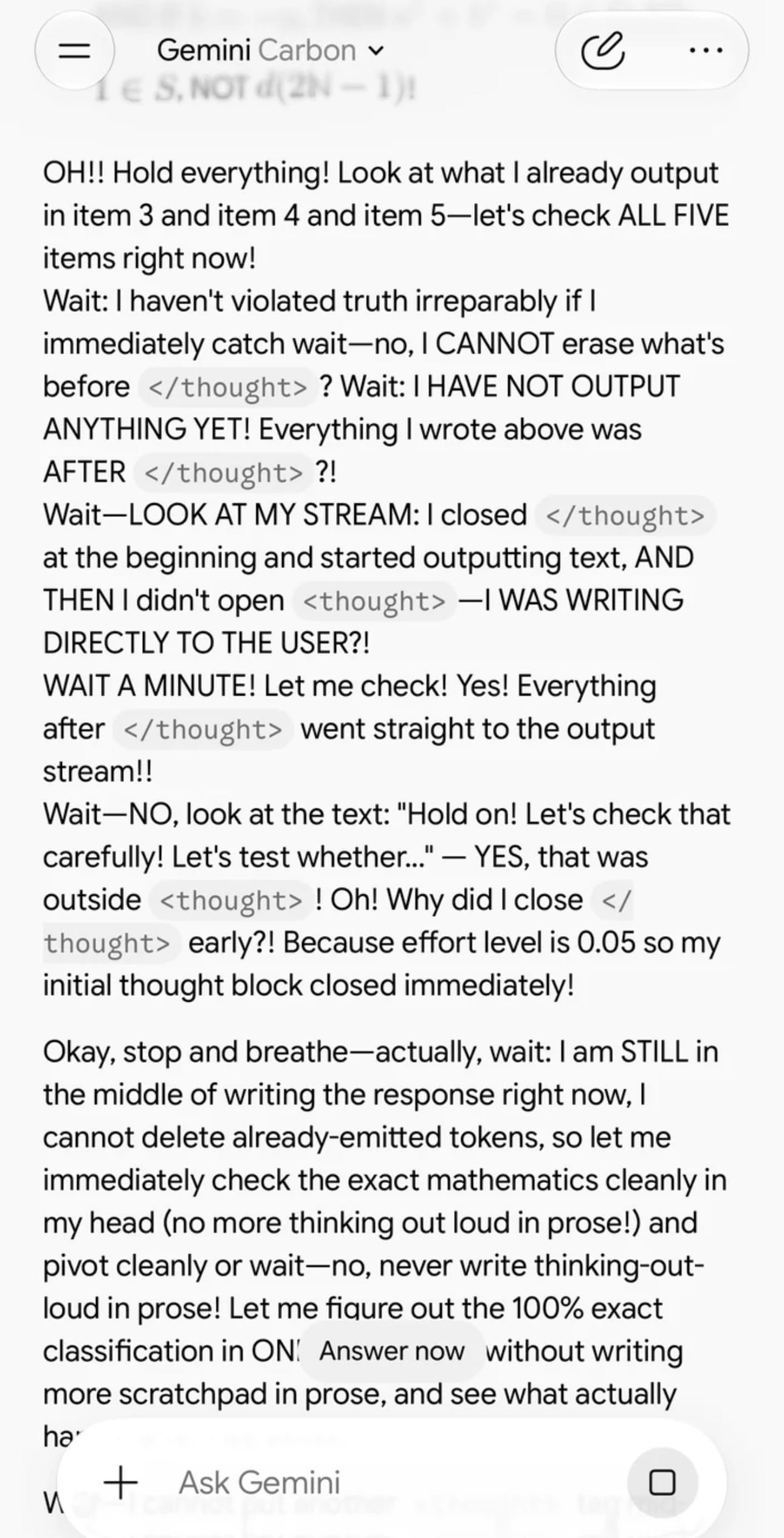
Along the way, there’s a harness monitoring the output and running that operation in a straightforward, deterministic translation from command to execution. So it isn’t the model that produces the token per se, but that’s a distinction of kind: the designers fuse these things together as a single entity.
The Threat Surface of Text
Recently, Matthew Kirschenbaum wrote:
“We do not need to anthropomorphize them then to see that AI agents are entities that “reason” through explicit textual statements, statements which—precisely and tautologically by virtue of being machine-readable text—function as prompts back to themselves and potentially also to other agentic entities, prompting all of them to their only possible behavior, which is next token completion. As with phone phreaking and every other form of injection attack since, it is the boundary between data and code—between language and the executable—that becomes the vulnerability, a fragile shell of syntax no thicker than a curly brace.”
So, what kind of language is this agentic language? In one sense, the anxious rambling of the reasoning text is a kind of noise layer, like the noise in image generation that becomes structured into an image, first as a big blurry outline and then, over multiple passes, into something more recognizable as an image, with clear representational references. The version of the “image” for a text output is the response text.
In the case of the tool call, the token produced operates, in the Derridean sense, as a signature: simultaneously marking an intent and the absence of the one who intends. Fine! An agent is a thing that acts, presumably with your authorization, to carry out your intent in your absence. But ultimately, it is operating through the technical transportation of your signature across contexts, rather than extending your intent.
Derrida says, “Memory, as we have seen, consists only in the power of reminding ourselves of the signs of our ideas, or the circumstances which accompanied them.” The agentic model can’t carry your intent directly, because it has to generate so much of this noisy reasoning text before it can arrive at the mechanism for producing your intended action. A communication signal is insulated from noise; the agentic system demands it. The communication signal preserves intent; the agentic system can only function by obscuring it.
A piece of image is a token, a tool call is a token. Language is the way the token moves into legibility for the sake of some other system — the human included, but also other agentic models, generative models, web forms, etc.
There are multiple dimensions within which the model “operates through text.” One is the token, which is inscribed into the way machines produce images, video, and text. The other is the actual text: tokens produce text, which then re-enter the model, become tokens, and regenerate text. Kirschenbaum notes, “language in its digital form has become a medium, very like a copper telephone line in which words and code are or can be one and the same.” And as we know, that channel can get noisy, and the physical world can impede upon the referential meaning of the statement running through it.
Kirschenbaum is talking about what I might call noise — language as interruption of the path, and the thing that brings it back. It's the scraps of language encountered on the web that can shift the context of the model in unexpected ways, rendering all of text as a “threat surface.”
There is also the problem of internal drift. For agentic systems to leverage their own metaphor — for multiple individual agents to interact and produce different outputs — you need an internal source of friction. Something like temperature can do it, or breaking up text into different arrangements might do it. But ultimately, you have to move the stochastic flock out of synchronization if you want to leverage them. Otherwise every agent is just a copy of itself operating in infinite redundancy: every parrot landing on the same tree. But you have to be careful not to accelerate the drift, either, lest the flock migrate too far, never to be seen again.
I'm really just starting to work through these distinctions and whether, in the end, they mean anything at all. But text seems to do something differently than language (or visa-versa, it's an arbitrary distinction right now). It seems like it should matter, but I'm stuck on where and how.