Understanding as Proof of Error


Clarice Lispector, Translation, and Artificial Intelligence
I'm a writer who fears the snare of words: the words I say hide others - Which? Maybe I'll say them. – Clarice Lispector, A Breath of Life
To translate a work of literature is to select its absences. In a piece from 2018, Katrina Dodson wrote about translating the work of Clarice Lispector, called "Understanding is the Proof of Error," showing us clearly that the work of translation is tied to a labor of empathy.
Translation, she says, means noticing what the author left out. The chosen word carries the residue of the words-not-chosen — it does the work of what's missing, of what was selected against. Close readers find absences evoked in what arrives: the translator shapes text to make that absence felt. The machine works in the opposite direction. The word the softmax function returns is what's left after the alternatives are cut away. The discards leave no computational residue — nothing in them shapes the words to come. The translator's word-not-chosen has a different kind of residue, with absences arranged in ways that make the reader feel them.
In the era of attention mechanisms, selected words steer the selection of what comes next. A language model builds each word's meaning from the words before it, then predicts what is most likely to come next. More than one word influences the next, but every word selected narrows the range of acceptable choices even further. An author's choices – what makes a literary voice – is choosing words that create frictions against what's expected. A human translator preserves not just these unlikely choices, but what the absence of the likely choice signals to the reader. In contrast to the friction a translator fights to preserve, a model by default produces the word that follows most smoothly.
The latest models generate "reasoning traces." These are longer, often behind-the-scenes texts that describe choices and deliberation, and can resemble this process of selection. It's the same mechanisms as earlier systems, just more of them, and tuned to produce an answer, rather than the deliberation that yields it. By design, a system optimized to advance to the end of a sequence has no reason to preserve what was "left unsaid." But an answer, or a resolution in the form of a stop-token, is not always what we need in literary work.
Dodson suggests that the words-not-chosen by the author are just as important to the human translator as the ones that are. But the words not chosen, the words that follow the logical assumption of what comes next, are the words an LLM is currently structured to reproduce. It keeps the text within a tight scope of possible meaning, but the human process of choosing one word over the other seeks out what is unsaid.
 My Linh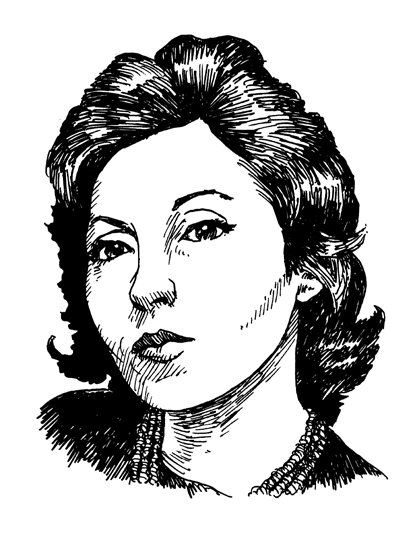
A Literature Review
Some studies have tried to examine this. Castaldo et al, a pre-print focusing on GPT-4 and Mistral (2023-era models), addresses this question of authorial intent most directly. They find that the text produced by machine translation systems "exhibit distinctive emotional fingerprints, reflected in systematic differences in how emotional content is distributed, intensified, or attenuated throughout the text."
Ferstler et al, in another pre-print, focuses on GPT-5.4, Gemini 3.1 Pro and what I understand to be an agentic translation process built with Claude Code: more modern than Castaldo. Most readers in the study preferred the human translator, though preference isn't a reflection of accurate translation. Rather, the readers found the machine versions to be clearer, but the human translations to be more literary and immersive.
Readers found the machine translations to be clearer, but the human translations more literary & immersive.
Fidelity to those choices, and that voice, is harder to test: the language is, quite literally, not the same. Within the same language, I've tried – as part of my critical technical practice – many experiments trying to get LLMs to write like I do. I have eight+ years of training material, and it still doesn't get it quite right. The scale of what we can write is also part of our voice.
The Failure of My Language
Dodson's piece takes its title from a Lispector line: "Understanding is the proof of error." I find it echoed in this passage, from The Passion According to G.H. –
Reality is the raw material, language is the way I go in search of it - and the way I do not find it. But it is from searching and not finding that what I did not know was born, and which I instantly recognise. Language is my human effort. My destiny is to search and my destiny is to return empty-handed. But – I return with the unsayable. The unsayable can only be given to me through the failure of my language. Only when the construction fails, can I obtain what I could not achieve.
Inevitably falling short of perfection is part of being human, and a system designed only to reach perfection doesn't meet us where we are. A machine isn't "inhuman" because it makes mistakes, but because it cannot fail: it follows the rigid commandments inscribed in its structure and corpus without any distance or remainder. Lispector reminds us that the experience of being human is already constituted by a tension between what we cannot grasp and what we become by reaching.
"It is curious that I can't say who I am. That is to say, I know it all too well, but I can't say it. More than anything, I'm afraid to say it, because the moment I try to speak not only do I fail to express what I feel but what I feel slowly becomes what I say." – Clarice Lispector, Near to the Wild Heart
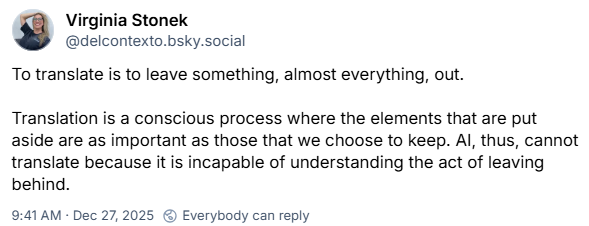
The human strives for language because of a gap that language opens and cannot fill, but the machine constructs from language only that which language can say. There is no gap for language to fill, a lack of any lack, and therefore, no way for it to fall short.
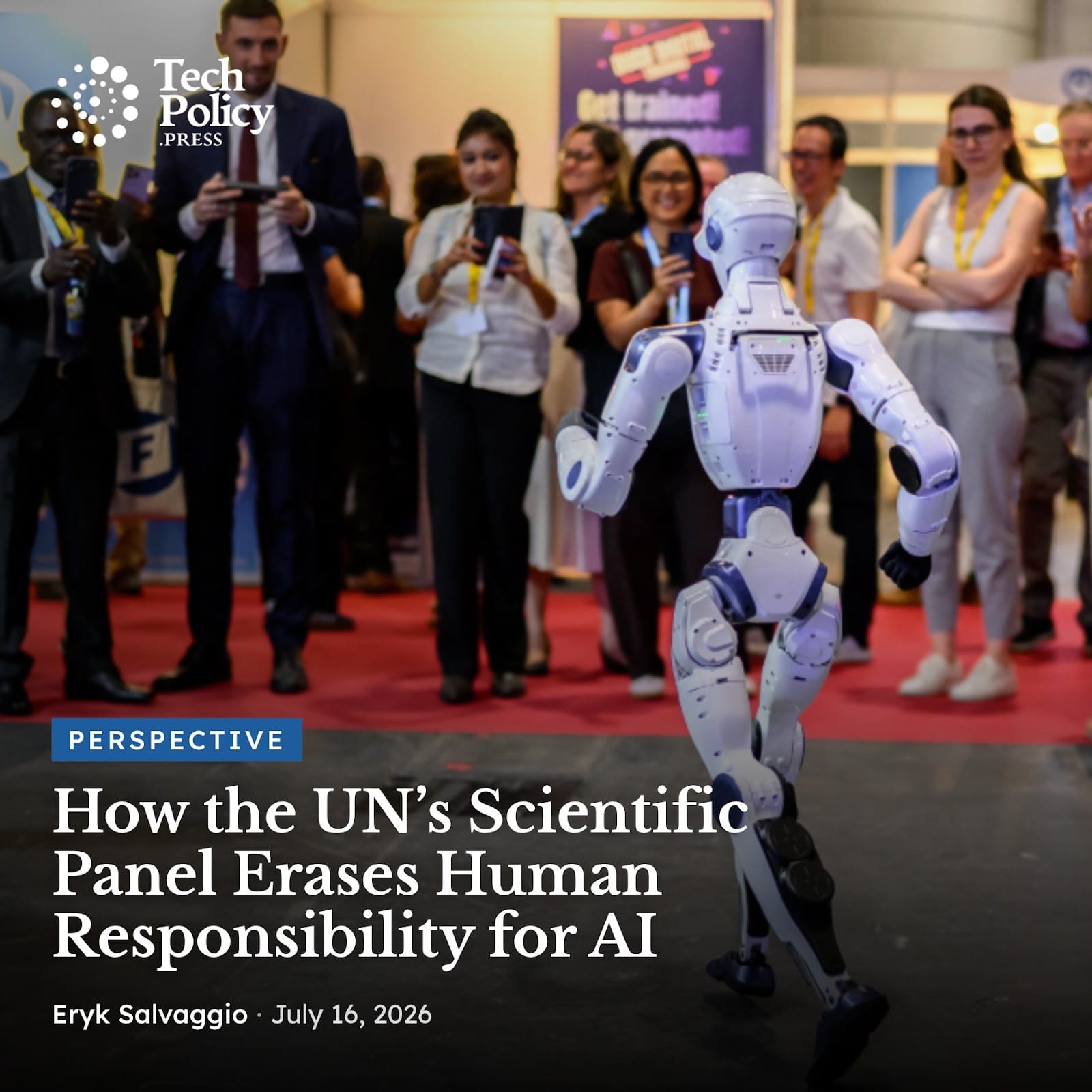
Where is the human in the UN's definition of AI?
My latest for Tech Policy Press looks at the evolution of language describing "AI" in major policy projects, and shows how an existential risk frame has crept in, forcing human accountability out. The trend culminates most bizarrely in the UN's Independent Panel report: in it, we see not only how the definition reflects a "system from nowhere," but how that framing of the system constrains the options the report makes available to policymakers.