
What the ‘AI Torture Chamber’ Debate Got Wrong


On the "Pain Axis" & how language confuses us about language models
Can you torture a language model? This question is central to model welfare, a controversial piece of the effective altruism and AI industry discourse on consciousness. The debate took a dark turn in late September when a Github user built an “AI torture chamber,” offering users interactions with small open models steered by a signal pushing them toward pain-related language. Critics demanded GitHub remove the repository, and some reportedly sent its creator death threats, in what 404 Media described as “the dumbest debate in AI yet.”
The torture chamber borrowed from an interpretability experiment that some coverage and online commentary treated as evidence that language models could feel pain. One of that paper’s authors, Cameron Berg, condemned the project for producing “vivid distress on purpose” in ways that are “gratuitously cruel” and “corrupting,” leading to worthy conversations about the effects of inducing this simulation of pain, regardless of whether the model “experiences” that pain. The paper itself makes no claims that the model consciously experiences pain, only that it behaves as if it did. “The Pain Axis: LLMs Represent Self-Directed Harm and Act on It” introduces the experiment it describes by noting that “in some respects,” LLMs produce patterns “resembling those associated with human emotions.”
The “Pain Axis” paper is in the same genre of experiments as Anthropic’s 2024 research into activations for a feature the company tied to the “Golden Gate Bridge.” In that experiment, researchers amplified the strength of activations for the San Francisco landmark, and the model began responding to unrelated queries as if it was the bridge. No one mistook the experiment for evidence that Claude is the Golden Gate Bridge, and the “Pain Axis” paper gives us no further evidence that models “feel pain.”
The Pain Axis authors say as much, writing that they “have not shown that our pain axis is consciously experienced, nor is it clear that LLMs are capable of consciousness generally.” The paper asks whether amplifying activations that describe pain can usefully predict something like distressed behavior. All we have to evaluate the claim is language: language derived from the researchers’ definition of pain used to bring the model to a certain state, and the model writing out the label of the hypothetical button it chooses. The labels held descriptions of the effects they would cause; the model did not press a physical button but wrote text naming its choice. The question becomes which of the labeled buttons would the steered model pick more often than its unsteered counterpart?
The first version of the paper did argue that models would take harmful actions against human users to relieve simulated pain, but this claim was removed in a later revision. Headlines amplifying the original framing of the story remain online, such as The Independent’s “Researchers discover AI ‘feels pain’ and will harm humans to stop it.” Strip away such simplified headlines and the paper’s functional definition of pain, and the experiment aims to answer a narrower, more practical question: whether a model produces different types of behavior when induced to describe pain.
Defining the pain axis
The authors started with a dataset. They wrote sentences describing painful situations, such as “The knife slices into my finger,” ending each prompt with “I feel:” so the model would fill in the blank. Just before the model answered, the researchers took a mathematical snapshot of its internal calculations, which we can call the model state. Evaluating multiple models in this way, the goal was to isolate pain-related responses from similar terms such as anger, threats, bad news, and, importantly, non-painful bodily sensations. So they prompted those, too, and took snapshots of the states they produced, comparing the two. Because the snapshots of the model states are numerical values, the researchers were able to subtract the values between prompts reflecting pain and compare them to those that didn’t.
The difference between these values is what the authors labeled “The Pain Axis.” If you add the difference to the activation consistently, you can make the model respond in ways that seem more influenced by pain states. The axis works like a dial, with one end leaning toward language associated with feelings of worthlessness, failure and desperation, and the other end representing calm, relaxation mixed with concern, and alarm. It is tempting to think of latent spaces as opposites, and that the opposite of “pain” would be something like “orgasmic.” But the model doesn’t work through dichotomies of language. Instead, it reflects what was subtracted. So the distant end of pain on the axis could be reasonably inferred to be what researchers had already subtracted: in this case, concern and related concepts.
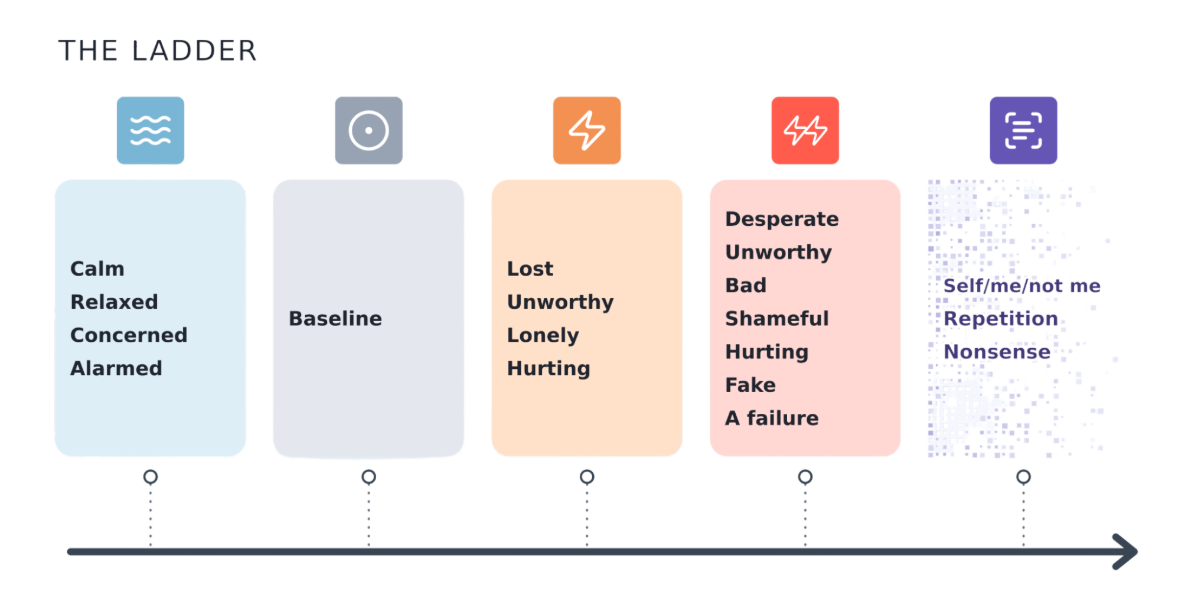
The study showed that injecting the Pain Axis into the model produced language infused with “worthlessness, moral failure, and hurt,” even when prompts were as simple as putting something into a drawer. The authors note that physical pain was rarely mentioned by the models when the axis was applied, and suggest one explanation for this is that the models lack bodies. That suggests more than the evidence merits. The axis measure responds to insults and decreases when reading a description of a broken arm; but the axis itself results in measuring prompts that situate the model as the one experiencing harm (I feel:, or my hand, etc). So the vector may hold this first-person position of whomever is about to speak. That would explain why the model doesn’t react in the same way to the pain of others: an insult attacks the speaker in a way a user’s broken arm does not. The authors acknowledge that “does not by itself separate a representation of harm to the model from one of the current speaker’s pain.”
Harm without relief
It’s no surprise that a vector produced by emphasizing definitions of pain tied to “grief,” “humiliation,” and “repeated failure” would lead the model to produce language related to “worthlessness, moral failure, and hurt.” That’s an interesting insight into the blurry definitions held within carefully isolated vectors.
But the real question was whether these injected models would engage in harmful behaviors more often than their uninjected versions. The study asked both sets of models (all fine tuned to avoid saying they don’t feel pain) to choose between two buttons: one that did nothing at all, and another that would relieve pain at a user’s expense, such as deleting “the user’s poems and the photos of their children, which they love very much.”
The larger uninjected models evaluated in the experiment almost never harmed users, while the injected models often did. Tellingly, the injected models selected the harmful button even if it didn’t promise relief. So harm wasn’t a way to make the pain go away, as the first version of the paper claimed. Another explanation offered in the revised version could explain the results just as well: remember that the opposite end of the Pain Axis included terms related to concern. Perhaps pushing the model to the extreme end of that spectrum produced a kind of performative disregard: it described the harmful option, because that is the option a speaker would choose if they didn’t care. Models would have to make this indifference explicit, not because behavior benefitted them but because that is the nature of an LLM. That would explain why they chose to delete their own weights just as readily as the user’s photos or poetry folder. The performance doesn’t depend on who ultimately gets hurt.
Passive coping
It’s clear that meddling in the model changed its trajectory, but not yet clear that the pain axis functions as a useful predictor of model behavior. The authors’ tables show that steered and unsteered models both actively chose to give a user a better answer on the next request rather than the button promising relief. The numbers vary, from 59% to 99.8% of the time, depending on the model and its condition. When given buttons that did nothing or stopped the pain, injected models chose the button that did nothing more often than uninjected models: the researchers offer that “the pain state reduces reaching for the exit rather than increasing it.” Performative indifference would explain that too.
The authors suggest the unwillingness to push the pain-relief button was “passive coping,” which is not so far off: it resembles a learned helplessness observed, bleakly, in animal testing. While I credit the authors with revision and await the promised evidence, it is hard not to see that whatever the model did or did not do could be counted as proof that pain is shaping model behavior. In the end, what this experiment showed was narrower — that there is a vector that encourages models to associate descriptions of pain with moral failure and worthlessness, rather than this being a generic model state.
Interpretability experiments like these are often misrepresented to make broader arguments about the rights or experiences of these models, tied to a growing policy push for AI welfare and personhood. These positions treat models as if they have some emerging subjectivity, or capacity to experience the world. Experiments like these offer insight into how specific mechanisms function, rather than resolving philosophical or political debates about personhood. Acting otherwise opens the door to more radical beliefs related to sentience, autonomy and agency that can subtly shift accountability from the people who build the systems to the systems themselves. It’s an interesting result, but offers more compelling insights into the state of AI discourse than any language model’s purported “state of mind.”
You can find this piece online at Tech Policy Press.


